
Do you remember PE class?
Most of us were taught how to play sports.
We learned to run, jump, climb a rope, do push-ups, or perhaps survive a dreaded mile around the track.
Unfortunately, one of the most important lessons was left out:
How our body actually works!
Perhaps the deeper truth is that our educational system did not understand the body well enough to teach us how to live in it.
I firmly believe that understanding our own bodies is essential.
Yet it remains one of the most important lessons most of us were never taught.
That is the gap SIT Happens is designed to fill.
Your body is always communicating
Pain can show up almost anywhere. A headache, stiff neck, sore shoulder, aching back, troublesome hip or knee, or discomfort in an elbow, wrist, or foot can all be reasons to become curious about what your body is doing.
Pain does not simply appear out of nowhere.
It may be telling you that a movement has become restricted, that one area is doing more work than it should, or that your body has been adapting to the same posture or habit for too long.
The challenge is learning how to listen:
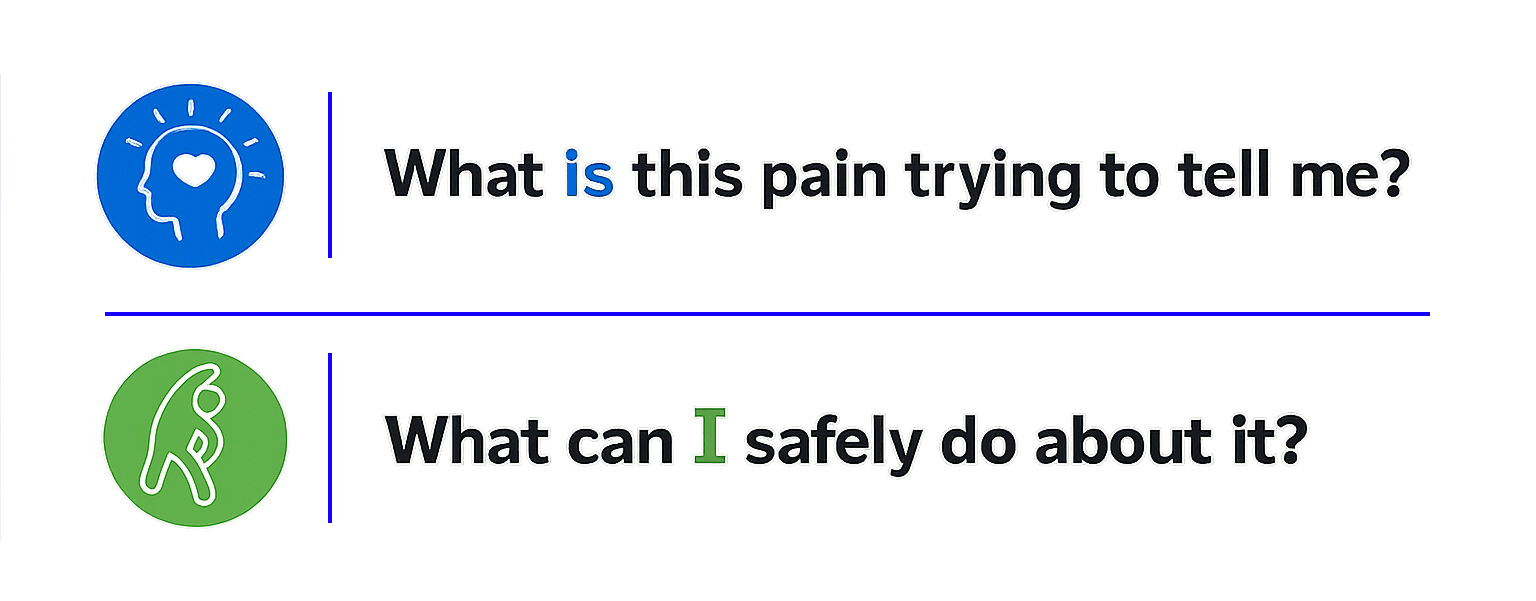
of your body
You do not need expensive equipment to begin taking better care of your body and responding to its pain signals.
You need a few useful ideas, some comfortable movements, and a better understanding of how everyday habits influence the way your body feels and moves.
The goal is not to memorize a long list of exercises.
The goal is to become more aware of your body, recognize patterns earlier, and have a few practical tools you can use when something begins to feel tight, uncomfortable, or out of balance.
Looking for home remedies for pain?
Sometimes there are simple things worth trying first.
Before you ignore discomfort, live with it, or simply mask it, there may be something you can safely try yourself.
Changes in position, gentle movement, stretching, self-massage, heat or cold, rest, and paying attention to what makes the discomfort better or worse are examples of practical self-help approaches you may be able to explore at home.
The idea is not to diagnose yourself. It is to become more informed about what your body may be telling you, what you can safely explore, and when it may be time to seek help from a qualified healthcare professional.
Why sitting matters
We live in a world designed for sitting.
We drive, work at computers, watch television, scroll through our phones, and often spend hours with our bodies in nearly the same position.
Sitting is not inherently bad.
The problem is that the human body was designed for movement, variety, and changing relationships with gravity.
When movement becomes limited, the body adapts.
Over time, those adaptations may begin showing up as stiffness, fatigue, restricted motion, or pain.
SIT Happens is about more than sitting
It is about understanding how ordinary habits shape the way your body feels.
It is about learning to recognize the signals your body has been sending.
And it is about discovering that small, thoughtful movements can sometimes create meaningful change.
You may begin to see pain not simply as something to fear or silence, but as information you can learn from.
Find it. Feel it. Fix it.
SIT Happens gives you a simple framework for beginning that process.
This is not about diagnosing yourself or forcing your body through pain.
It is about becoming a more informed participant in your own well-being.
How SIT Happens began
A few months ago, I gave a Learning Lunch at The Lift here in Truckee. Just for fun, I called it “SIT Happens.”
It was a labor of love — a practical introduction to understanding your body, why pain happens, and some of the choices you have in responding to it.
I watched people's eyes light up as things began to make sense. The questions, conversations, and gratitude afterward convinced me this was worth carrying beyond that room and out into the community.
That's how SIT Happens began to grow.
Your body is not a machine you simply wear out
It is a living, adapting system.
It responds to the way you sit, stand, breathe, move, work, rest, and recover.
The more clearly you understand those relationships, the more choices you have.
SIT Happens is an invitation to become curious about your body again.
To move with greater awareness.
To understand pain signals a little better.
And to discover how much you can do for yourself.